
The NOUR Project
Among the more targeted entrepreneurship initiatives currently active in the West Bank is the NOUR Project - Nurturing Opportunities for Uplifting Resilience - a World Bank-funded program implemented by MA'AN Hub in partnership with MA'AN Development Center. The World Bank's support for NOUR sits within its broader mandate to strengthen economic resilience and private sector development in fragile and conflict-affected contexts, and Palestine represents one of the more challenging operating environments in its portfolio. Channeling funding through a community-rooted implementing partner like MA'AN - an organization with decades of development experience and an established presence in Palestinian civil society - reflects a deliberate approach to ensuring that resources reach the grassroots level rather than circulating only among the larger, more visible players in the ecosystem.
Where many ecosystem programs focus on tech startups and scalable digital products, NOUR takes a different entry point: young women and other eligible individuals aged 18 to 35 who have a business idea or an early-stage venture but lack the capital, skills, and institutional support to move forward. This is not a program for founders who are already investor-ready or who have polished pitch decks. It is a program for people at the beginning - those who have identified an opportunity, have the motivation to pursue it, but have never had anyone sit with them and help them build a plan, stress-test an idea, or understand what it actually takes to run a sustainable small business.
The project operates across three governorates - Ramallah, Hebron, and East Jerusalem - reflecting a deliberate effort to reach beyond the capital and engage communities where entrepreneurship support has historically been thinner on the ground. Ramallah, as the administrative and economic center of the West Bank, already has more infrastructure than most - incubators, co-working spaces, NGO offices, and a relatively active business community. Hebron, by contrast, is a more conservative and industrially oriented city where the support ecosystem for young entrepreneurs is considerably thinner, and where women face a steeper set of social and cultural barriers to economic participation. East Jerusalem occupies a category of its own - politically complex, administratively fragmented, and cut off in many practical ways from West Bank institutions, yet home to a significant Palestinian population with entrepreneurial potential that is routinely underserved.
Reaching across all three of these contexts within a single program is itself a logistical and operational challenge. It requires locally embedded outreach, culturally sensitive engagement, and the flexibility to adapt program delivery to very different environments. It also requires strong partnerships - which is precisely why MA'AN Hub has invested significant effort in building its institutional network on the ground.
What the Program Offers
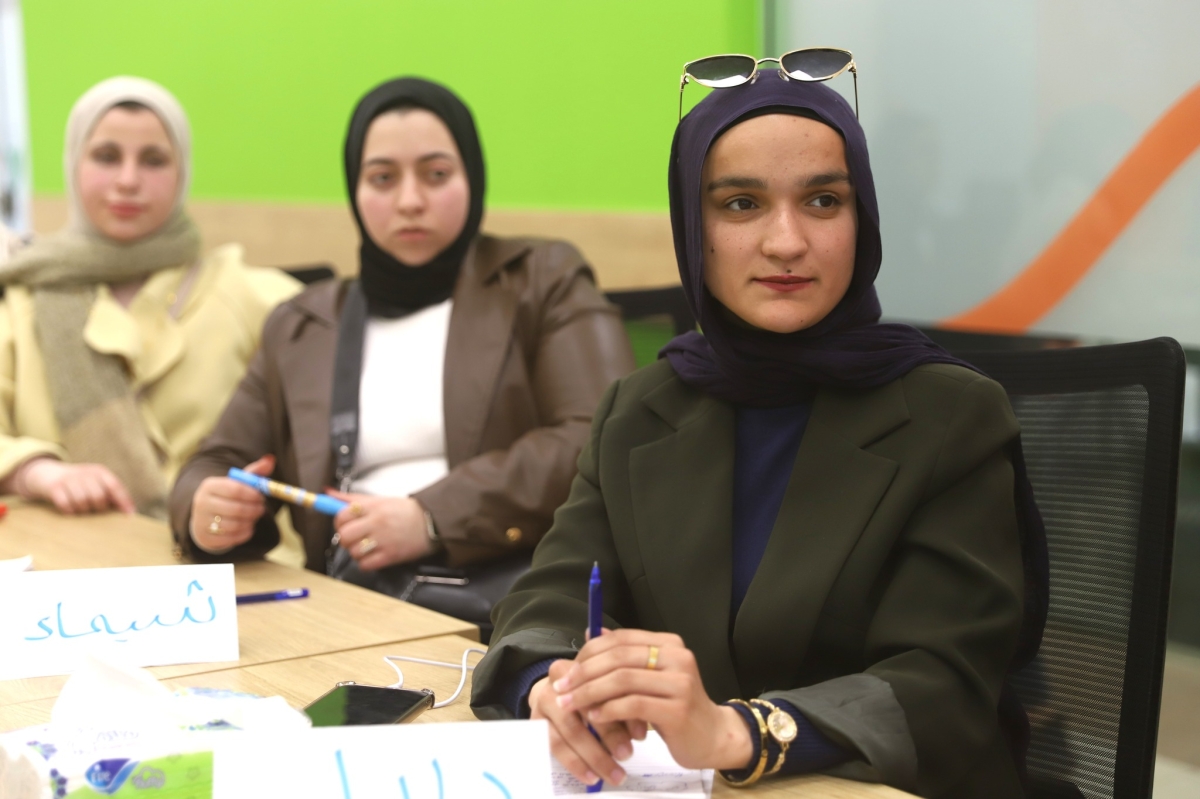
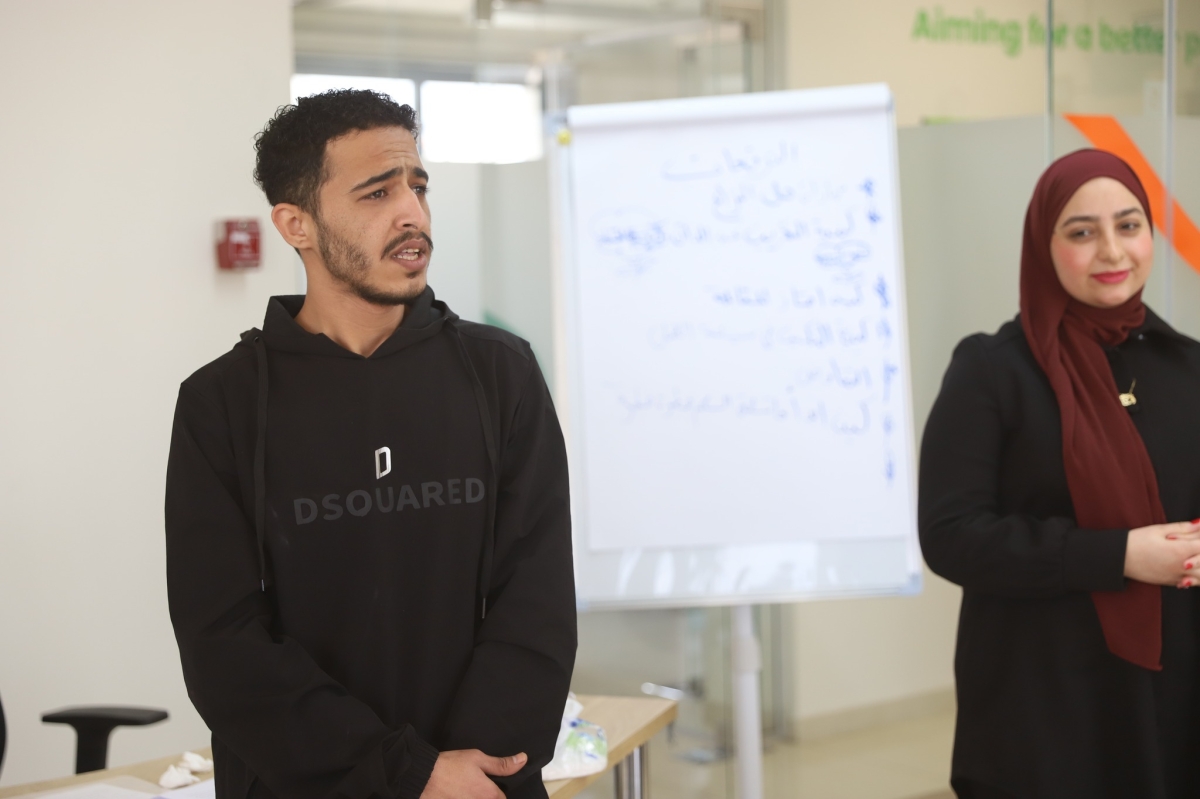
Beneficiaries of the NOUR Project go through a structured support journey that integrates several components. Business development training forms the foundation - covering essentials such as market analysis, financial planning, pricing, customer acquisition, and the basics of formal business registration and compliance. For many participants, this is the first time they have encountered these concepts in a structured way, and the training is designed to be practical and applicable rather than abstract.
Alongside the training, each beneficiary is matched with a mentor - a business professional or experienced entrepreneur who works with them on a one-on-one basis to develop their specific idea or venture. Mentorship of this kind is particularly valuable in the Palestinian context, where informal networks and personal connections play an outsized role in business success, and where young women in particular often lack access to the kinds of professional relationships that their male peers might acquire through family connections or prior work experience.
The seed funding component is what gives the program its real economic weight. Participants who successfully complete the training and demonstrate a viable business concept are eligible to receive seed grants that provide the initial capital needed to launch or expand their enterprise. This could mean purchasing equipment, covering initial inventory, setting up a workspace, investing in a basic digital presence, or any number of other early-stage needs that would otherwise remain out of reach. The grants are not loans - there is no repayment obligation - which removes a significant barrier for young women who may have no credit history, no collateral, and no family backing to absorb the risk of a loan that doesn't work out.
Beyond training, mentorship, and funding, the program also works to connect beneficiaries with the broader economic ecosystem - linking them with potential customers, suppliers, business networks, and follow-on support mechanisms that can help them sustain momentum after the formal program period ends.
Why Women, and Why Now
The focus on young women is not incidental or cosmetic. Palestinian women face a distinct and compounding set of structural barriers when it comes to starting and growing a business. Access to formal credit is limited - banks typically require collateral that most young women do not have, and microfinance products, while more accessible, often carry interest rates that make them unsuitable for the early fragile stages of a new venture. Cultural expectations around mobility, family responsibilities, and the social acceptability of women operating independently in certain business environments add another layer of friction. Professional networks, which are critical to finding customers, partners, suppliers, and mentors, tend to be organized in ways that exclude or underrepresent women. And in most mainstream accelerator and incubator pipelines in Palestine, female founders remain a minority.
None of this means Palestinian women lack ambition or capability. The evidence consistently points in the opposite direction - women who complete business training programs in Palestine tend to show strong outcomes, and female-led microenterprises have historically demonstrated resilience and community embeddedness that larger ventures sometimes lack. What they lack is structured support, and that is precisely what NOUR is designed to provide.
The timing of the program also matters. The current period - with the war in Gaza continuing to reshape economic conditions across the West Bank - has deepened unemployment, suppressed household incomes, and increased the economic pressure on Palestinian families. Women have borne a disproportionate share of that pressure, both as economic actors who have seen their livelihoods disrupted and as caregivers absorbing the broader social fallout of the crisis. Interventions that strengthen women's economic agency in this context are not peripheral - they are central to any serious effort at economic stabilization and recovery.
Institutional Partnerships
To extend its reach and credibility, MA'AN Hub has been building a network of institutional partners to support beneficiary outreach, referral, and engagement. These partnerships are not symbolic - they are operational, grounded in signed agreements and shared responsibilities.
The Business Women Forum Palestine is one of the program's key partners. As an established network representing businesswomen across the West Bank, it provides MA'AN Hub with access to organized communities of women entrepreneurs and business owners who can both serve as role models and mentors for NOUR participants, and feed into the program's referral pipeline. The Forum's credibility with its membership gives the partnership real practical value.
The Ramallah Chamber of Commerce and the Federation of Palestinian Chambers of Commerce bring a different but complementary dimension. Their memberships include the MSMEs, established business owners, and sector associations that form the economic fabric of Palestinian commercial life. Connecting NOUR participants with these networks opens doors to potential customers, suppliers, and business relationships that would otherwise be difficult for a young entrepreneur to access independently. It also signals to the broader business community that the program's graduates are credible, supported, and worth engaging with.
These partnerships reflect a broader understanding that sustainable entrepreneurship support cannot operate in isolation. An incubator or a grant program that exists as an island - disconnected from the banks, the chambers, the sector associations, and the informal networks that actually drive economic activity - will produce graduates who complete the program and then find themselves without the connections they need to succeed. By anchoring NOUR within these institutional relationships, MA'AN Hub is building a bridge between its beneficiaries and the real economy.
A Longer-Term Vision
The NOUR Project runs through March 2028, giving it a meaningful operational runway to build, test, and refine its approach. Over that period, it will produce a cohort of trained, funded, and mentored entrepreneurs across Ramallah, Hebron, and East Jerusalem - women who have gone through a structured process and come out the other side with a functioning or growing business, a set of practical skills, and a connection to a broader network.
The ambition is not just to support individual beneficiaries, but to shift the landscape slightly - to demonstrate, through concrete results, that young Palestinian women given the right support can build viable businesses, and that investing in this population generates real economic returns. Success stories from NOUR have the potential to influence how future programs are designed, how donors allocate funding, and how the Palestinian private sector thinks about women's economic participation.
In a broader sense, NOUR represents something important about where Palestinian entrepreneurship support needs to go: away from a sole focus on high-growth tech startups visible at international conferences, and toward a more inclusive model that meets entrepreneurs where they actually are - in Hebron's old city, in East Jerusalem's crowded neighborhoods, in Ramallah's peripheral suburbs - and gives them what they need to take the next step. That is the kind of ecosystem building that rarely makes headlines, but that over time makes the most difference.
Album